Description
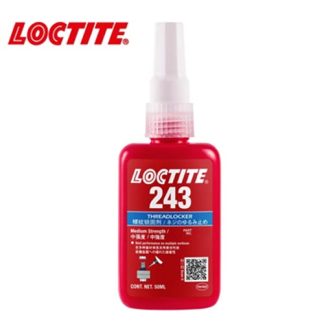
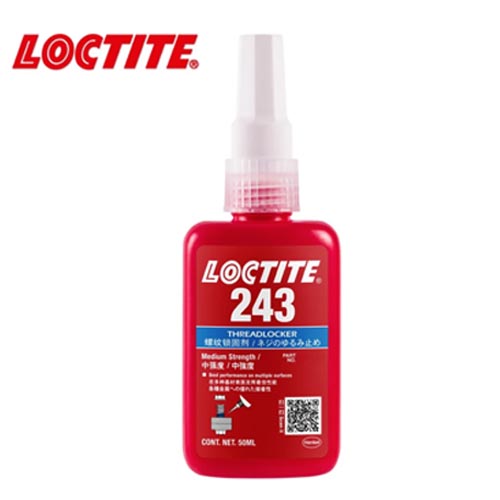
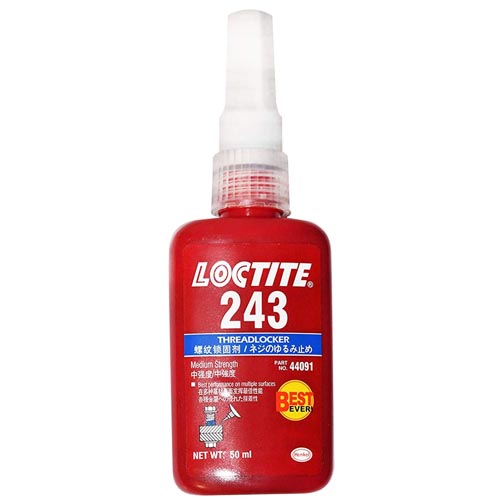
- LOCTITE 243 is a general-purpose threadlocker that provides a medium-strength bond.
- Works on all metals, including passive substrates such as stainless steel, aluminum, and plated surfaces. It is proven to be tolerant of minor contamination due to industrial oils, e.g., motor oils, corrosion prevention oils, and cutting fluid.
- Prevents loosening on vibrating assemblies, e.g. pumps, gearboxes or presses
- Works on all metals, including passive substrates (e.g. stainless steel, aluminum, plated surfaces)
- Proven to tolerate minor contamination by industrial oils, e.g. motor oils, corrosion prevention oils, and cutting fluids
- Permits disassembly with hand tools for servicing
- Designed for the locking and sealing of threaded fasteners which require normal disassembly with standard hand tools The product cures when confined in the absence of air between close fitting metal surfaces and prevents loosening and leakage from shock and vibrations thixotropic nature of LOCTITE 243 reduces the migration of liquid product after application to the substrate
- Provide robust curing performance. It not only works on active metals (e.g. brass, copper) but also on passive substrates such as stainless steel and plated surfaces.
- The product offers high-temperature performance and oil tolerance. It tolerates minor surface contaminations from various oils, such as cutting, lubrication, anti-corrosion and protection fluids.
Certification:
- Registered to NSF Category P1 : for use as a sealant where there is no possibility of food contact in and around food processing areas
- Certified to ANSI/NSF Standard 61 for use in commercial and residential potable water systems not exceeding 82° C.
TYPICAL CURING PERFORMANCE:
- Cure Speed vs. Substrate: The rate of cure will depend on the substrate used. The graph below shows the breakaway strength developed with time onM10 steel nuts and bolts compared to different materials and tested according to ISO 10964.
- Cure Speed vs. Bond Gap: The rate of cure will depend on the bond line gap. Gaps in threaded fasteners depends on thread type, quality and size The following graph shows shear strength developed with time on steel pins and collars at different controlled gaps and tested according to ISO 10123
- Cure Speed vs. Temperature: The rate of cure will depend on the temperature. The graph below shows the breakaway strength developed with time at different temperatures on M10 steel nuts and bolts and tested according to ISO 10964
- Cure Speed vs. Activator: Where cure speed is unacceptably long, or large gaps are present, applying activator to the surface will improve cure speed. The graph below shows the breakaway strength developed with time on M10 zinc dichromate steel nuts and bolts using Activator 7471™, 7649™, 7088™ and 7091™ and tested according to ISO 10964
General Precaution Information:
- This product is not recommended for use in pure oxygen and/or oxygen rich systems and should not be selected as a sealant for chlorine or other strong oxidizing materials.
- For safe handling information on this product, consult the Safety Data Sheet (SDS).Where aqueous washing systems are used to clean the surfaces before bonding, it is important to check for compatibility of the washing solution with the adhesive.
- In some cases these aqueous washes can affect the cure and performance of the adhesive.
- This product is not normally recommended for use on plastics (particularly thermoplastic materials where stress cracking of the plastic could result). Users are recommended to confirm compatibility of the product with such substrates.
Directions For Use
For Assembly
- For best results, clean all surfaces (external and internal)with a LOCTITE® cleaning solvent and allow to dry
- If the cure speed is too slow, use the appropriate activator. Please see the Cure Speed vs. Activator graph for reference. Allow the activator to dry when needed
- Shake the product thoroughly before use
- To prevent the product from clogging in the nozzle, do not allow the tip to touch metal surfaces during application
- For Thru Holes, apply several drops of the product on to the bolt at the nut engagement area
- For Blind Holes, apply several drops of the product to the lower third of the internal threads in the blind hole, or the bottom of the blind hole
- For Sealing Applications, apply a 360° bead of product to the leading threads of the male fitting, leaving the first thread free. Force the material into the threads to thoroughly fill the voids. For bigger threads and voids, adjust product amount accordingly and apply a 360°a bead of product on the female threads also
- Assemble and tighten as required
For Disassembly
- Remove with standard hand tools.
- In rare instances where hand tools do not work because of excessive engagement length, apply localized heat tonut or bolt to approximately 250 °C. Disassemble while hot.
- Apply localized heat to the assembly to approximately250 °C. Disassemble while hot.
For Clean up
- Cured product can be removed with a combination of soaking in a Loctite solvent and mechanical abrasion such as a wire brush.
Technical Information:
- Brand: Loctite
- Trade Name: Loctite 243
- Application: Threadlocking
- Strength: Medium
- Cure Time: 2 Hr
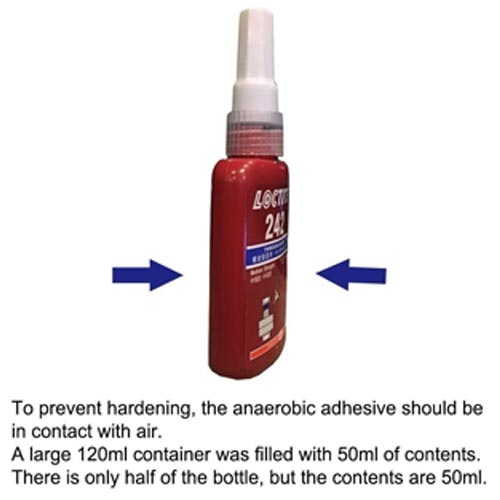
- Anaerobic: Yes
- Colour: Blue
- Key Substrates: Metal: Brass, Metal: Steel, Metal: Steel – Stainless Steel
- Product Form: Liquid
- Package Type: Bottle
- Package Size: 50 ml
- Maximum Operating Temperature: +180°C
- Minimum Operating Temperature: -55°C
- Viscosity Description: Thixotropic
- Chemical Composition: Dimethacrylate Ester
- Special Features: Anaerobic
- Specific Gravity: 1.08
- Operating Temperature Range: -55 → +180 °C
- Setting Time: 5min
- Product Dimensions: 5.8 x 2.6 x 15.8 cm; 82 g